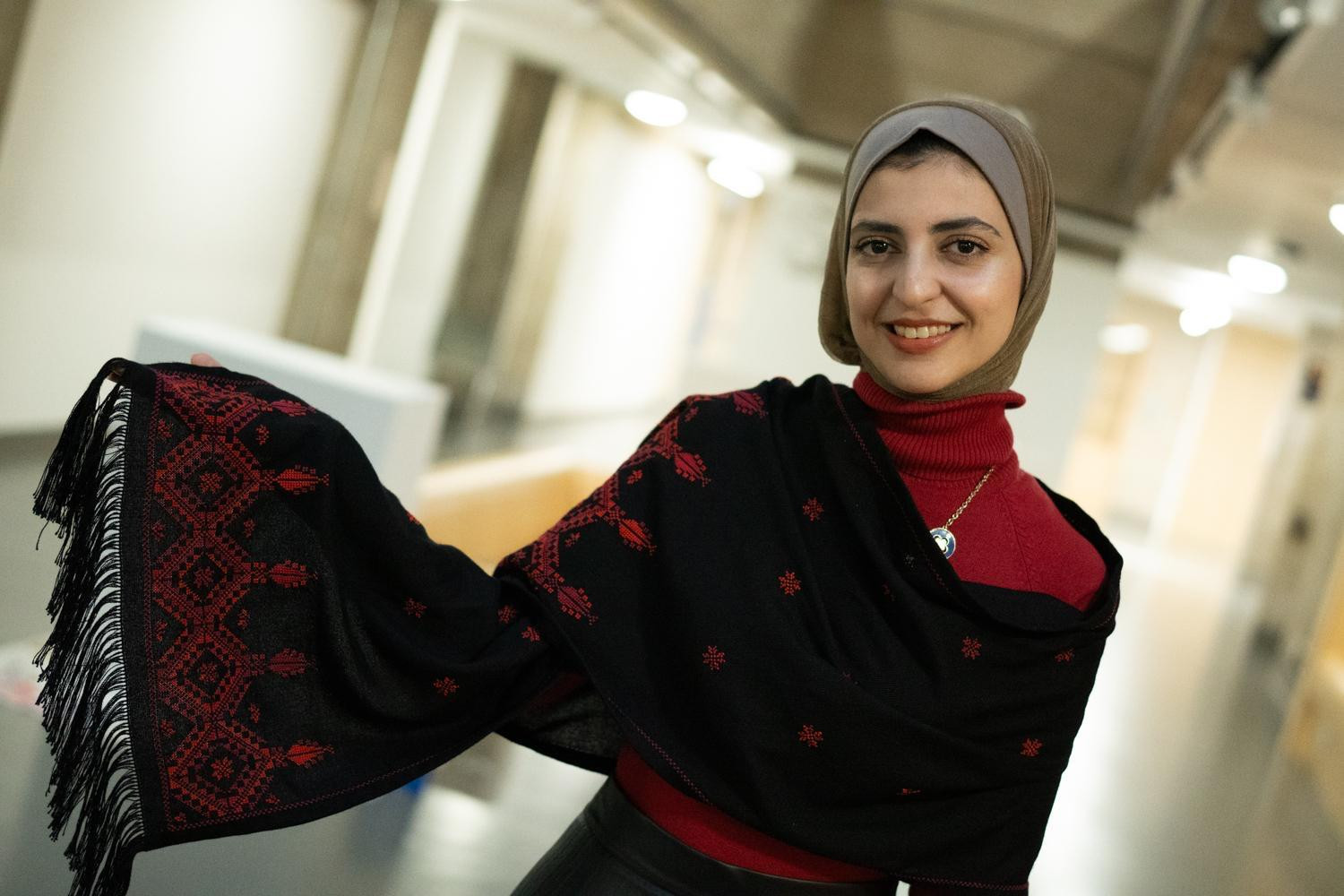
➣On the anniversary of the day she fled Gaza, Alaa Alqaisi reflects on the meaning of survival, the moral economy of a life spared, and the feeling of living in extra time.
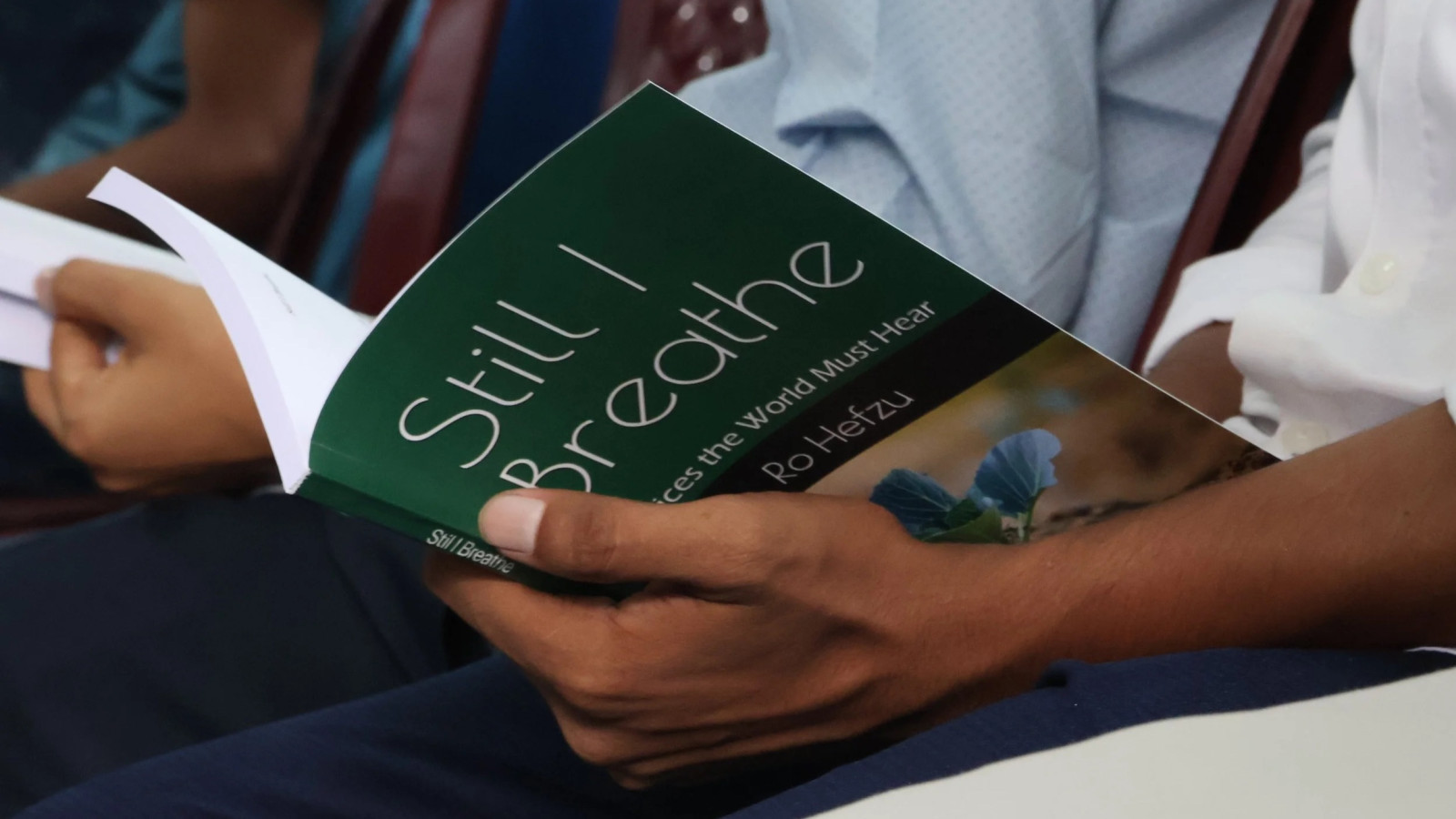
➣First published recently by Skein Press Shared with the explicit permission of author and publisher.
The Thin Border
Survival, at present, seems to me less like an escape than a body studded with thorns, so densely that there is hardly a patch of skin left untouched. You begin, slowly, to pull them out with your bare hands. One place bleeds while another has already begun to heal; one wound surprises you with its depth, while another, which you had believed unbearable, has somehow closed without your noticing.
Every thorn hurts more as it leaves than it did while it was lodged inside, and with each one that comes free there arises, almost intact, the cry of the years during which it remained buried. Perhaps pain does not always announce itself when it appears. Perhaps there are forms of suffering that the body can endure only by postponing its knowledge of them. While the thorns are everywhere, it’s best not to touch them because there is no part of your body from which to begin. You continue through a kind of prolonged anaesthesia, performing whatever life requires, crossing the next street, finding the next shelter, making the next phone call, asking who is alive, who has arrived, who has disappeared, where you will sleep, whether there will be food, until pain becomes not so much an event but an atmosphere.
Only later, when danger loosens its grip enough for the body to notice itself again, do you discover what has been living beneath the numbness. Safety, or whatever approximation of safety one is given, does not necessarily remove pain. Sometimes it is precisely what allows pain to emerge.
This is one of the contradictions: survival is spoken of as though it were the end of something, whereas it actually inaugurates an entirely different labour. To survive is to be handed back to yourself in a condition you no longer recognise, then asked to resume the ordinary tasks of living.
You must learn how to inhabit a place that does not resemble any that you know and cannot possibly fill the spaces genocide has torn out of your inner life. You are expected to make appointments, remember passwords, respond to emails, attend meetings, make plans for next month, consider what you might want from the future. These activities seem so mundane to everyone else that their strangeness is almost impossible to explain. You find yourself suspended between two systems of reality: the one your body has learned, in which everything can vanish within minutes, and the one surrounding you now, in which people speak confidently of the next year.
You are trying, simultaneously, to extract the thorns of one life and plant the beginnings of another. The difficulty lies in having to move towards one life without ever fully leaving the other. You stand on the thin border between two worlds, looking backwards and forwards at the same time, while some part of you continues to run in both directions. And perhaps because I did not know how to simply live after having spent so long learning how not to die, I began to make another bargain with existence. I measured my worth through what I could produce. I worked. I wrote. I accepted another task, another deadline, another project. I operated at what felt like four hundred per cent of my capacity and called it ambition, discipline, gratitude, resilience, anything except what it sometimes was: an inability to believe that being alive, by itself, was sufficient reason to occupy space. There is a peculiar moral economy that can emerge after catastrophe, in which life feels as though it must continuously justify having been spared. Rest becomes suspicious. Idleness becomes almost unbearable. A day in which nothing has been accomplished can feel, irrationally but powerfully, like a day in which one has failed to repay a debt.
So I turned survival into productivity, and productivity into evidence that survival was not wasted. I became extraordinarily capable while remaining strangely unpractised in the simpler art of being alive. I know how to endure, how to work beyond exhaustion, how to respond to crisis, how to carry several lives at once; what I do not know is how to sit inside a quiet afternoon without turning it into a task. I am beginning to suspect that this, too, is one of the thorns.
Whenever something becomes difficult now, when fear enters an ordinary situation or when I become anxious before a journey, a room, a conversation, an unfamiliar road, I tell myself – sometimes jokingly and sometimes entirely seriously – that I survived a genocide, so how could I possibly fail to survive this? I remind myself that I once crossed a street with military tanks stationed ahead of me, running because the only thing left to rescue was my own life, and I ask why my body should tremble now in places where no tank is waiting. I say these things to myself until courage, or at least its temporary imitation, returns. Then I continue.
I have learnt how to manufacture fearlessness from memory, how to take an old terror and set it against a smaller one.
I also know that this argument hinges on a lie, because my survival was never proof of exceptional courage, superior instinct or some hidden strength that distinguished me from those who did not survive. There were people more courageous, more careful, stronger than I was, who were killed.
Survival cannot be retrospectively transformed into a virtue without insulting the dead.
My survival belonged to God's decree, to a life whose appointed end had not yet arrived, and also, in the brutal mechanics of those days, to contingencies so small that they continue to unsettle me.
Once, on Al-Shuhada Street, a bullet passed so close to my head that I felt it like a breath on the back of my neck. I sometimes think about the mathematical insignificance of that distance. During the siege of the YMCA, when I fled, my life depended, in part, upon an Israeli soldier not choosing to fire at that moment. There is a humiliation particular to the knowledge that, for an instant, the continuation of your entire existence can be contained inside the decision of a stranger who possesses a weapon and has been granted the power to decide whether you will keep breathing. In Gaza, the Israeli occupation repeatedly reduced Palestinian life to precisely this obscene arbitrariness, as though whole streets had been transformed into the setting of a hunting game whose players could decide who would move, who would stop, who would be allowed through.
Another night during a belt of fire, a concentrated succession of strikes meant to engulf an entire area, the distance between death and myself was approximately the thickness of a wall. I slept knowing that, only a few metres away, people still lay beneath the rubble. Survival, when examined closely enough, loses the clean narrative we prefer to give it. It becomes a wall standing where it happened to be erected, a bullet travelling along one trajectory rather than another, a soldier making one decision instead of its opposite, a few seconds gained somewhere in the confusion.
I can call this chance; I can call it fate; I can call it God's will. None of these words, however, release me from the ensuing questions. This survival was given to me and withheld from others whom I loved, from friends, relatives, children, people whose attachment to life was no less fierce than mine.
There is no moral arithmetic capable of explaining why one person remains while another is taken. This is why gratitude alone cannot contain survival, and why the language of being “lucky to be alive” often feels too small for what has happened. Luck is an unbearable word when it stands beside the names of the dead. The real questions come after the escape, beyond the border, following those first nights in which the sky no longer explodes above you. What do you do with a life that has been returned to you in this way? How do you receive it without imagining that you earned it? How do you honour those who were not granted the same chance without converting your own existence into an endless punishment? And how, most difficult of all, do you learn to desire something for yourself again without feeling that desire is a betrayal?
I think constantly of the survivors in Gaza, because survival there has not been allowed to become real. I think of my mother and father, my siblings, my friends, the children of my family and the children of Gaza. I think of the exhausting intervals through which they continue to survive, one reprieve followed by another threat, in the midst of an ongoing genocide that persists even beneath the diplomatic vocabulary of a ceasefire. What kind of survival is this, when survival itself must be renewed every morning? They deserve a complete survival, the kind that does not have to be renegotiated with hunger, displacement, bombardment, destroyed hospitals, closed borders and the disappearance of the most basic conditions of ordinary life. Sometimes I think they deserve it more than I do, although I know that this is another impossible calculation, another attempt to distribute a thing that should never have been made scarce.
Because I know Gaza, I also know that devastation is experienced not only through significant geographical or socio-political events, but through details whose accumulation eventually becomes an entire philosophy of abandonment. People must think about water, bread, medicine, transport, batteries, tents, walls, roads, the price of vegetables, whether a child can sleep, whether an elderly parent can walk, whether someone has heard from a cousin, whether there is enough flour, whether a neighbourhood is still safe to enter, whether a house that remains standing is inhabitable. The media speaks in numbers because numbers are easier to absorb than lives, but people experience catastrophe through the disappearance of ordinary things. Gaza now feels like a vast territory of disappointment and exhausted possibility, and I can understand those who might look at the scale of abandonment and wonder how we ever dared to hope at all. Even there, hope does not quite disappear. It becomes stranger, thinner, less triumphant. Gaza seems to live now by drawing on the faith of its old women, on Darwish's incurable hope, and on whatever remains of a past from which the country can still feed itself. When the future has been systematically destroyed, people begin to survive on memory. Then, for a moment, a world that has been physically erased resumes its existence.
Perhaps this is why writing has become so difficult for me. Almost every attempt at it lately feels futile, not because I have nothing to say but because I no longer entirely trust the conditions under which I am saying it. I keep losing the voice I had in Gaza – the voice that did not ask permission before speaking. I was less afraid there, strangely enough. Not less afraid of death, but less afraid of language. I wrote from inside experience rather than from the position of someone explaining experience to others. Anger did not have to introduce itself politely. Grief did not have to become legible. Contradictions could remain contradictions. My feelings arrived together, without being filtered according to what would sound reasonable, publishable, balanced, appropriate, or sufficiently comprehensible to someone who had never stood where I stood.
Now the voice hesitates. It watches itself. I sometimes feel that even my anger leaves me moderated, wavering, professionally dressed. It has learned manners I never taught it. Part of this is displacement, I think, and part of it is the strange psychic demand placed upon Palestinians outside Palestine, who quickly discover that speaking is not merely a matter of telling the truth but of calculating the conditions under which truth will be permitted to remain audible. I become conscious of myself as a Palestinian before I have even finished being myself. Perhaps this is what I mean when I say that I do not entirely feel that I belong, or sometimes that I even deserve the space I occupy. Exile can turn self-consciousness into a second climate. I enter a room and part of me enters first, scanning it.
I try, therefore, to summon the voice I had before, not because it was simpler, but because it was less conscious of how it might be received. I could write anger without first moderating it, and tenderness without worrying that it would weaken what I was saying. Now I notice myself adjusting almost every sentence, anticipating how it might be read, misunderstood, resisted, or made more acceptable. Part of this comes from writing between Arabic and English, but part of it comes from living outside the place in which those experiences were self-evident. I find myself explaining what once required no explanation, providing context for things that were simply part of daily life, and choosing language carefully because I know how quickly certain words can change the way a reader listens. The difficulty is not only that I am translating experience for others; it is that, over time, this constant adjustment starts to affect the experience itself. Eventually I begin to wonder what remains untranslated in me, and whether that untranslated part is not perhaps the truest one. I become unsure of where my own voice ends and where this habit of explanation begins, and I keep returning to writing in the hope of hearing, beneath all that caution, something that still feels entirely mine.
Since leaving Gaza I have entered many countries, and I often joke that after being trapped there for thirty years I now cannot stop travelling. The joke amuses people, and sometimes it amuses me too, though it stems from something much less humorous. For most of my life the world was a set of places that existed beyond borders I could not freely cross. Then, almost abruptly, airports, trains, visas and new cities became part of my life. I expected distance to diminish the occupation's reach.
Instead, I found that Israel is not only in Palestine. I began to recognise the structures that sustain it everywhere: in institutions, political language, cultural spaces, universities, media, the selective distribution of sympathy, and the astonishing ease with which Palestinian suffering can be doubted, qualified or converted into an abstract debate.
I crossed countries and found that the occupation can travel without checkpoints. Its power circulates through languages, policies, silences, allegiances and habits of thought. Palestinians, meanwhile, are repeatedly expected to present evidence of wounds the world has already watched being inflicted.
So I did not entirely escape the occupation by leaving its geography. In some ways, I began to encounter its larger geography.
This does not mean that every place is Gaza, nor that every form of power is identical. It means that distance complicated what I had imagined distance would do. The border did not divide my life neatly into captivity and freedom. I was free to move, perhaps, but I carried knowledge that movement could not erase. The occupation remained present in the emails, the questions, the institutions, the conversations in which Palestine suddenly became a test of how carefully one could speak. It remained in the strange experience of being physically removed from the violence while watching it continue to consume everyone and everything that had formed me.
Gaza, meanwhile, keeps appearing everywhere. It leaps into every road I take. Its few farms appear inside the vast green fields and forests through which I pass, as though one topography were written faintly beneath another. I can be looking at a landscape entirely foreign to me and suddenly recognise an arrangement of light, a colour of earth, a tree or a smell or a stretch of sky; something that opens the hidden door through which memory enters. Places begin to contain other places. A road can carry another road inside it. A window can resurrect a window long shattered. Another sea can become unbearably close to the sea I knew, even when its colour, temperature and coastline are entirely different.
Sometimes this goes further than resemblance. My mind simply assumes that things have continued without me: that the friends I lost are somewhere living out the rest of their days, that Refaat Alareer will return to teach, that my family’s house is still standing. These thoughts do not arrive as memories or wishes. For a moment, they feel like facts.
And the horizon. The horizon is where the distance is defeated completely. Wherever I go, Gaza seems to run towards me from it. I used to think of leaving as a movement away from a place, but I have learned that once a place has entered the body deeply enough, geography no longer obeys maps. You can leave a city and continue walking inside it for years. You carry its proportions without knowing you do. The body remembers distances, from the house to the sea, from one room to another, from the doorway to the garden. Then another city unwittingly reproduces one of these distances, and memory wakes before you have consciously understood why.
There are moments when Dublin resembles some of my farthest dreams. It contains things I once desired with an almost embarrassing simplicity: streets one can walk without anticipating where death might come from, libraries, galleries, trains, the possibility of making appointments weeks in advance, the assumption that a building standing today will probably remain tomorrow.
I can sometimes see the life I might have loved here if I had arrived as another version of myself. If my heart were not so crowded with scars, if memory did not exercise such sovereignty over it, if the enormous evil consuming my country were not still capable of reaching across continents and devouring something in me as well – perhaps this city would have taken my whole heart at once. I might have surrendered it without resistance, without constantly turning my head towards what I had left behind.
Sometimes I feel that I am living in extra time, after the two halves of the match have already ended. I do not mean that I have stopped caring what happens to me. I simply find myself doing what I want with far less fear, without thinking everything through twice or calculating every possible consequence. I make plans, work, travel, take chances. Somewhere beneath all of that, though, there is a certain indifference towards life that I did not have before. Once you have spent enough time believing there may be no later, the future does not simply recover its old authority because you are safe. I move towards it with my eyes open, almost fearless at times. Not because fear has left me. My body can still panic over small things.
Fear simply no longer convinces me in the same way. I have already seen how little caution can guarantee.
The ground here does not feel like the ground I knew. That ground carried me without requiring anything from me. I never thought about belonging to it, because I did. Here, I sometimes feel that I do not set my whole weight down. Instead, I carry pieces of myself with me. This is more than homesickness. Gaza was not somewhere I happened to live; it was the scale by which I understood the world. Distances, weather, streets, danger, home, the sea, other people, even my own body made sense inside it. To lose a place in that way is also to lose some of the measurements by which you recognised yourself.
At times I feel less like someone who left one life for another than someone who has returned from the first one. I do not know how to explain that distinction aloud, or whether there is even a distinction anymore. I survived; I know this to be a fact. Still, there are moments when survival feels too simple a word for the distance between the life I was certain would end and the one I suddenly found myself continuing.
Sometimes I cannot tell whether I came close to death and lived, or whether some part of me crossed into it and was sent back. I do not feel reborn. Nothing began again. I simply found myself here, with time I had already stopped believing would be mine.
Extra time is the closest language I have for it. I do not know what extra time asks of me, or whether it asks anything at all. I only know that I am inside it now, living days I did not expect to have. I am still learning how to belong to a future I had already stopped imagining.